Digital Advertising vs Traditional Advertising
Introduction
Advertising is an essential part of marketing that helps businesses promote their products and services, attract customers, and increase sales. With the development of technology, advertising has evolved into two major forms: digital advertising and traditional advertising. Both methods aim to reach the target audience and create brand awareness, but they differ in their platforms, costs, reach, and effectiveness.
Digital Advertising
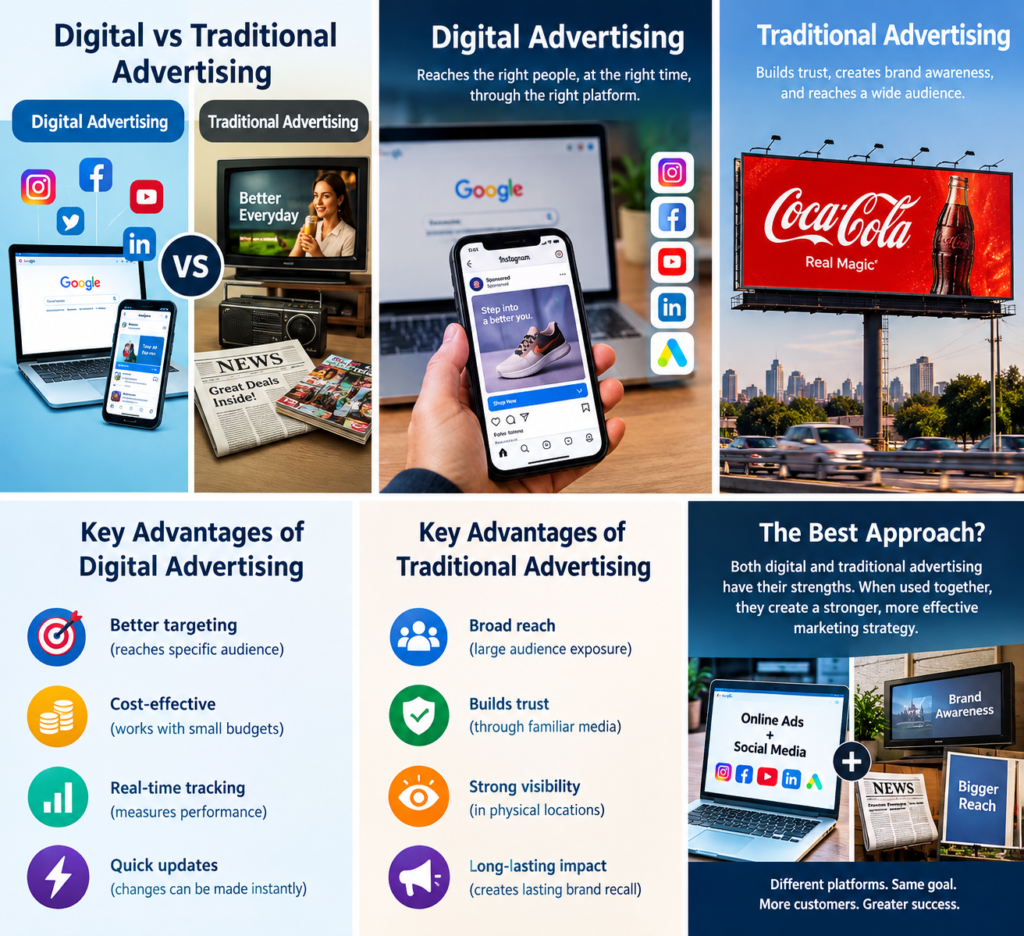
Digital advertising refers to the promotion of products and services through online platforms and digital technologies. It includes advertisements on social media, search engines, websites, mobile applications, email, and video-sharing platforms such as YouTube. Popular platforms for digital advertising include Instagram, Facebook, Google, and LinkedIn.
One of the biggest advantages of digital advertising is its ability to reach a specific target audience. Businesses can display advertisements based on customers’ interests, age, location, and online behaviour. It is also cost-effective because companies can start campaigns with relatively small budgets. Another major benefit is real-time performance tracking. Advertisers can measure clicks, views, engagement, conversions, and sales to understand how well their campaigns are performing.
However, digital advertising also has some disadvantages. People may ignore online advertisements, use ad blockers, or become annoyed by excessive promotional content. Additionally, businesses must compete with numerous advertisements on digital platforms, making it difficult to capture customers’ attention.
Traditional Advertising
Traditional advertising refers to promotional methods that existed before the widespread use of digital media. It includes television commercials, radio advertisements, newspaper ads, magazines, billboards, posters, brochures, and flyers.
Traditional advertising is effective for reaching a broad audience, especially people who regularly consume television, radio, or print media. It can create strong brand recognition and establish trust among customers. For example, a television commercial shown during a popular programme can reach millions of viewers. Similarly, billboards placed in busy areas can attract the attention of commuters and pedestrians.
However, traditional advertising can be expensive, particularly television commercials and advertisements in major newspapers. It is also more difficult to measure its exact performance compared with digital advertising. Furthermore, businesses generally have less control over targeting specific customers and cannot easily change a printed advertisement once it has been published.
Key Differences
The main difference between digital and traditional advertising is the medium used to communicate with customers. Digital advertising uses the internet and electronic platforms, whereas traditional advertising relies on established media such as television, radio, newspapers, and outdoor displays.
Digital advertising usually offers better audience targeting, flexible budgets, and measurable results. Traditional advertising, on the other hand, can provide broad exposure and strong visibility in physical locations. Digital campaigns can be updated quickly, while traditional campaigns may require more time and money to modify.
Conclusion
Both digital and traditional advertising play important roles in modern marketing. Digital advertising is particularly useful for businesses seeking measurable results, targeted audiences, and cost-effective promotion. Traditional advertising remains valuable for building brand awareness and reaching audiences through familiar media. The best approach depends on a company’s objectives, target customers, and budget. By combining both methods, businesses can create an effective advertising strategy that reaches a wider audience, strengthens brand recognition, and improves overall marketing performancel